
LTL Freight Class (NMFC) Explained
Learn what freight class (NMFC) is, and how to avoid costly freight reclassification fees
Freight class is the system most LTL carriers in the USA use to price palletized freight.
The National Motor Freight Classification (NMFC) groups commodities into standardized classes that reflect how dense the freight is, how easy it is to handle and stow, and how risky it is from a damage/liability standpoint.
There are classes from 50 to 500. Lower classes are typically denser and cheaper to move. Higher classes are lighter, bulkier, or more fragile and usually cost more to ship.
The four factors behind class (NMFC)
When carriers or auditors check your paperwork, they’re looking for evidence of these NMFC factors: density, handling, stowability, and liability.
1) Density
Density is how heavy the freight is for its size. It is measured in pounds per cubic foot (PCF), and all packaging and any overhang should be included when you calculate it. Denser freight usually gets a lower class.
Formula for freight density:
CUBIC FEET = (L × W × H in inches) ÷ 1,728
PCF (pound per cubic foot) = total weight (lb) ÷ cubic feet
Use this free freight density calculator to get the density of your shipment, based on dimensions and weight.
Note that calculating density is a useful starting point, but the NMFC is the authoritative system for carriers in the USA. Many commodities have specific NMFC items that override a simple density table.
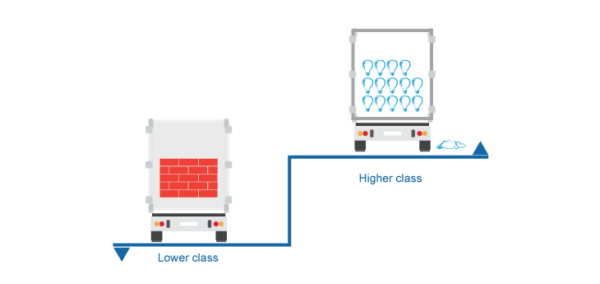
2) Ease of handling
Freight class also depends on how easy and safe it is to move the freight. Irregular shapes, sharp edges, or “extra fragile” items require special care.
The more careful a carrier has to be with your shipment, the higher your class is likely to be.
3) Stowability
Stowability describes how well the freight fits in a trailer and whether it can be stacked or placed efficiently with other freight.
Any limits that make loading harder reduce stowability (such as very long pieces, overhang, items that cannot be near other goods, or hazmat rules). If a shipment is harder to place or stack, it will usually have a higher class.
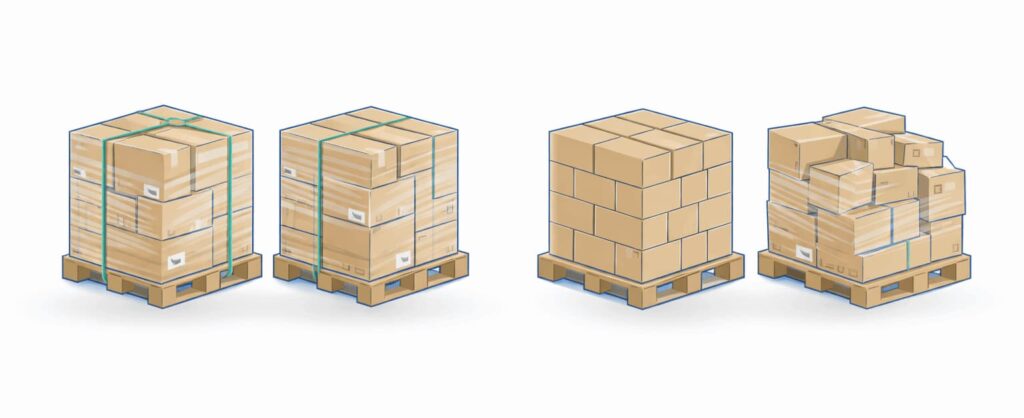
4) Liability
Liability essentially means risk of loss or damage. High-value, theft-prone, easily damaged, or hazardous goods carry more risk for the carrier.
More risk of loss or damage to the shipment usually means a higher freight class.
How carriers handle freight class in Canada vs. the USA
For Canada-to-Canada LTL freight shipping, carriers often price freight by space used or dimensional (cubic) weight, not by NMFC class.
For USA domestic and cross-border (USA⇄Canada) shipments, you should expect to provide a correct NMFC item and class on your paperwork and BOL.
Note: Listing an incorrect freight class during quoting or booking may lead to reclassification fees from carriers. If your shipment is going through the USA at any point, be ready with the correct NMFC item and class.
Unsure what NMFC / freight class to select for your shipment?
We can help! Contact us and we’ll confirm the correct class before you ship.
You can chat with us, call us at (800) 886-4870 Ext. 1 or email us at [email protected].
Reclassification: why it happens and how to prevent it
Carriers inspect shipments. If your declared class doesn’t match the commodity, measured density, or packaging, they can reclassify the shipment. These unexpected additional freight charges are never fun.
Common causes for freight reclassification:
- Dimensions didn’t include the pallet, packaging, or overhang.
- Actual weight exceeded the quoted weight.
- Vague commodity description (e.g., “machinery, NOI – no other info”) where a precise NMFC item exists.
- Packaging/stackability claims didn’t match reality (e.g. freight was marked stackable during quoting but it isn’t actually stackable).
- Stowability factors not disclosed (e.g. very long pieces, hazmat, can’t mix with other goods).
How to prevent freight reclassification:
- Measure exact external dimensions including pallet/packaging/overhang, to the nearest inch.
- Use precise scale weight (don’t guess).
- Describe the commodity precisely and select the correct NMFC item.
- Match your packaging and stackability notes to the physical freight.
- For USA and USA⇄Canada cross-border shipments, declare NMFC item and class on the BOL.
How to get the right freight class (NMFTA/ClassIT)
The most reliable source to confirm class is the NMFTA/ClassIT database (it’s subscription-based).
Freightera maintains a subscription, which we use to help our customers select the correct NMFC item and class.
Freight class FAQ
What freight classes exist?
Freight classes range from 50 to 500. Lower classes are denser, easier to handle, and cheaper to move, while higher classes are lighter, bulkier, or more fragile, and typically cost more to ship.
Does density determine freight class?
Not entirely. Density is a key factor, but handling, stowability, and liability also affect class. Many commodities have specific NMFC items that override what a density table alone would suggest.
What happens if my carrier reclassifies the freight?
The carrier will re-rate your shipment to match the audited measurements and class under their tariff. Providing accurate dimensions, weight, and NMFC item on your BOL helps prevent unexpected reclassification fees.
How do I find the correct freight class?
The most reliable source is the NMFTA/ClassIT database, which lists every commodity’s official NMFC item and class. It’s a subscription-based tool, and Freightera uses it to verify the correct class for customers. If you’re not sure what your product’s class is, contact us and we’ll check it for you and help you avoid reclassification fees.
Do I need a freight class for Canada-to-Canada LTL?
No. Canadian domestic LTL shipments are rated by dimensional or cubic weight, not by NMFC class.
Do I need a freight class for USA or cross-border shipments?
Yes. USA domestic and USA⇄Canada cross-border freight must include the correct NMFC item and class on your paperwork and bill of lading.
How Freightera helps you avoid reclassification fees
If you are our client and you are unsure about the class, you can tell us:
-
- What the product is and what it’s made of;
- Packaging type (pallet, crate, etc.);
- Exact external dimensions (L × W × H, including packaging/overhang);
- Total weight.
Our team will check the NMFC/ClassIT entry, confirm the proper NMFC item and class, and reflect it in your quote, helping you avoid reclassification and surprise charges.
After that, you can get instant LTL quotes and book online in minutes on Freightera, and ship with peace of mind.