
How to Avoid Extra Freight Charges
Why extra charges occur and how to keep your invoice clean and your costs predictable
Most extra charges in freight shipping happen when the shipment that shipped was not the shipment that was quoted. Accurate quoting, and proper preparation will prevent the majority of these fees.
When a charge is unfair, the paperwork and photos are what win disputes, especially with Freightera’s Rate Defense™ working in your favor.
What counts as an extra charge in freight
Most extra charges fall into three categories: specification changes, accessorials added after pickup, and time-based fees.
1) Specification-based adjustments
These are charges that appear when the physical characteristics of the freight do not match what was quoted. Common specification-based adjustments include:
- Reweigh charges when the actual weight is higher than the weight declared on the quote.
- Remeasurement charges when the actual dimensions are larger than what was originally entered.
- Reclassification (for the USA and the USA⇄Canada cross-border LTL) when the freight class or NMFC does not match the class you declared.
- Linear-feet or capacity pricing when freight uses more floor space or cube than standard LTL rules allow, and effectively behaves like a volume shipment or partial truckload.
2) Accessorials added after pickup
These are extra services that were actually used during pickup or delivery but were not selected during quoting. Typical examples include:
- Residential or limited access fees when the location is a home, home-based business, school, farm, storage unit, construction site, military base, or similar site.
- Liftgate and/or straight-truck charges when there is no dock or forklift, or when a 53 ft. trailer cannot safely reach the site.
- Inside pickup or delivery and/or driver assistance charges when the driver has to move freight beyond the curb or dock threshold.

- Trade show, Amazon FBA, construction site, storage unit, and similar surcharges that reflect added handling and coordination.
- Redelivery, reconsignment or diversion, storage, weekend service, and after-hours service when the original plan changes or the site is not ready.

3) Time-based charges
Time-based extras are tied to how long the driver and truck are occupied. Common examples are:
- Detention and waiting time charges when the loading or unloading goes beyond the carrier’s free-time allowance.
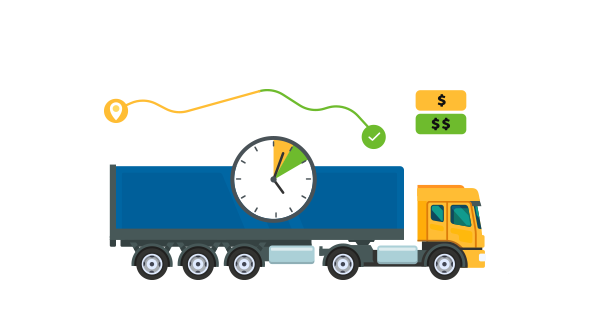
- Layover charges when the load must be held to the next service day because it cannot move forward as planned.
- TONU (Truck Ordered Not Used) for FTL shipments when a truck is dispatched but the shipment is cancelled or not ready.
How to avoid invoice surprises and extra charges in freight shipping
Accurate quoting and booking is the simplest way to avoid invoice shock. When your booked shipment matches what actually happens at pickup and delivery, your invoice will match your original rate.
Here’s what you need to do:
1) Measure your freight after packaging
Always measure length, width, and height after the freight is fully wrapped, strapped, and packed. Measure each pallet or crate to the highest point and always use the dimensions of the longest, widest, or tallest piece of cargo, and round up to the next whole inch. This is the only way to ensure your quoted dimensions match what the carrier sees.
2) Weigh the full shipment
If possible, use a reliable, calibrated scale and include the weight of pallets or crates. Enter the total weight for each individual piece. Understated weight is a common trigger for reweigh charges and re-rating. Alternatively, use a packing slip and add the weight of the pallet, skid, or crate to it to calculate the total weight of your pallet.
3) Use the correct freight class
For the USA and the USA/Canada cross-border LTL, using the wrong freight class or density can cause hefty reclassification fees.
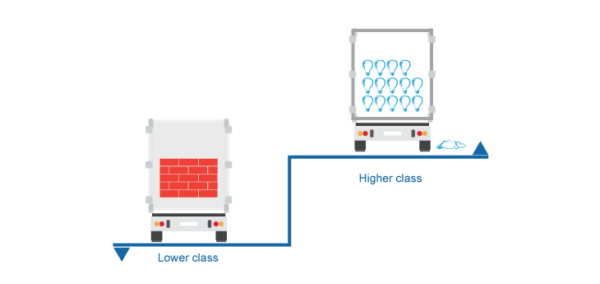
If you are not sure what the correct class is, contact Freightera with a description of your product (dimensions, weight, what the product is, what it is used for, what it is made of, and how it is packaged). Our shipping experts can help you look up or confirm the appropriate class so you can quote accurately. Chat with us.
4) Declare all accessorials at quote time
Think through the real-world conditions at both ends:
- No dock or forklift at pickup or delivery usually means you will need a liftgate.
- If you are shipping from or to a home or a home-based business, you should mark the location as residential.
- Sites with gates, guard shacks, schools, farms, storage units, military bases, and similar characteristics often count as limited access locations.
- Inside delivery, driver assist, appointments, hazmat, protect-from-freeze, trade show requirements, and Amazon deliveries are all additional services that must be selected while quoting.
For a deeper explanation of common accessorials and when to use them, see the dedicated article on accessorials and value-added services.
5) Select the right location type while quoting
Carriers increasingly use third-party address tools and their own data to tag locations as commercial, residential, limited access, and with or without docks. If their system sees your address as residential or limited access, they may add charges even if you did not select those options.

If you are unsure whether an address counts as residential, limited access, or a regular business with a dock, it is best to check with someone at the site.
6) Get informed
For detailed operational guidance beyond this overview, see our Help Center article “All-Inclusive Rates Guarantee.”
That article outlines practical steps that keep your quote aligned with your invoice and help prevent avoidable charges.
Valid vs. unfair charges & how Freightera’s Rate Defense™ protects you
Freightera’s Rate Defense™ challenges unfair carrier charges when your booking was accurate and the evidence supports your case.
Rate Defense™ is our process for protecting shippers from incorrect post-pickup fees.
Freight carriers bill based on what actually happened at pickup and delivery, but mistakes do occur: wrong location types, miscalculated dimensions, unnecessary liftgate charges, duplicated fees, or misapplied tariff rules. Left unchallenged, these extras can significantly raise the total cost of a shipment.
Rate Defense™ exists to prevent that outcome when your quote is accurate and your evidence backs up your claim.
Unlike many brokers who simply pass on carrier invoices, Freightera actively audits every disputed charge. We use all of the available evidence to dispute the charge if it’s deemed unfair. When something does not add up, we challenge the charge directly with the carrier on your behalf.
This matters because most individual shippers do not have the tariff knowledge, or established carrier relationships to successfully dispute fees on their own. Freightera handles that work for you. Our team knows the rules carriers use, what counts as valid evidence, and which charges can be reversed when misapplied.
In practical terms, Rate Defense™ helps you:
- Avoid paying for accessorials that you did not authorize or actually need.
- Reverse incorrect reweigh or remeasurement charges when your original measurements were accurate and documented.
- Correct misclassified locations (for example, when a commercial address is billed as residential).
- Remove duplicated or inconsistent fees that do not match the carrier’s tariff rules.
- Keep your total freight spend more predictable and fair over time.
Note that Rate Defense™ does not erase valid charges when the shipment or service needs truly differed from the quote, but it does protect you against avoidable, erroneous, or misapplied fees. With Freightera, you have a shipping partner with the expertise to resolve disputes quickly when the facts are on your side.
Extra charges in freight shipping FAQ
Why did my invoice end up higher than my quote?
Most of the time, the details of the actual shipment did not match the quote. The freight weighed or measured more than declared, needed extra services, took longer to load or unload, or went to a location type that was not selected at quote time. Carriers bill based on what actually happened.
Can detention or layover be removed if the driver only waited a little longer?
If the carrier time stamps show you went beyond free time and it affected their schedule, these charges are usually valid. The best way to avoid them is to have freight and staff ready, and to reschedule early if timing slips.
If the driver used a tailgate without asking, do I still pay?
If there was no dock or forklift and the tailgate was necessary to complete the delivery, carriers treat it as a valid fee. Proper equipment on site helps prevent this situation.
What proof helps dispute a reweigh or remeasurement charge?
Pre-shipment specs, photos with measurements or scale readouts, and a clear way to link them to your shipment (labels, PRO numbers, visible references). The clearer and more complete the evidence, the stronger your dispute.
How does Freightera help with extra charges?
We help you avoid them with accurate quoting tools and guidance, and we challenge unfair or inconsistent fees through our Rate Defense™ system when your booking details and evidence support your case.
Why did I get charged residential or limited access when I didn’t select it?
Carriers use their own rules and third-party address tools to tag locations as residential or limited access. If your site is in a residential area or is a school, farm, storage unit, construction site, military base or similar, they may auto-classify it and apply charges. Selecting the correct location type at quote time makes these costs visible up front and reduces surprises.
What happens if my pallet is a bit taller or heavier than I quoted?
Even small differences can trigger reweigh or remeasurement charges, especially in LTL where pricing depends on weight, dimensions and density. If the carrier’s scale or dimensions data shows higher numbers than your quote, they will re-rate the shipment. Measuring and weighing after packaging, and rounding up, reduces the risk of these adjustments.
Can I dispute a charge if I do not have photos or documents?
You can ask for clarification, but without evidence it is much harder to overturn a charge. Carriers will rely on their own scale tickets, dimensions data and timestamps. Keeping basic documentation (spec sheets, photos) gives us and our Rate Defense™ process something to work with and greatly improves your chances of removing the extra charges.
How quickly should I raise a dispute if I see an extra charge?
As soon as possible. Carriers work within strict billing timelines, and disputes raised late are much harder or impossible to reverse. At Freightera, we generally need to receive your dispute and supporting documents within 15 days of the invoice so we can act before the carrier’s window closes.
Will Freightera’s Rate Defense™ remove every extra fee on my invoice?
No. Valid charges that reflect real differences between the quote and what happened at pickup or delivery will still apply. Rate Defense™ is designed to protect you from unfair, inconsistent, or misapplied fees, not to erase legitimate carrier charges.