
Liftgates (Tailgates) in Freight Shipping
A practical guide to liftgate service: when to use it and what to expect
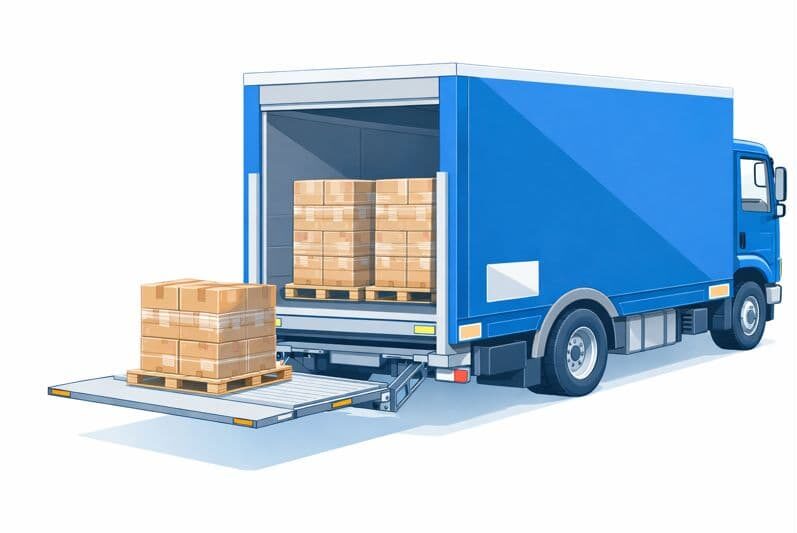
Liftgates (also called tailgates) are hydraulic platforms mounted to the back of a truck. They’re used in freight shipping to raise the freight from ground level up to the truck deck, and back down again.
If your shipper or consignee does not have a loading dock or a forklift, a liftgate is usually the simplest way to load or unload palletized freight.
This guide explains what a liftgate can and cannot do, typical liftgate limits, when to add the liftgate service to your quote, and how to avoid missed attempts and extra charges.
What a liftgate actually does
A liftgate is a hydraulic platform that raises freight between the truck deck and ground level, so palletized freight can be lowered safely and then moved on or off the truck using a pallet jack. It’s the most common solution for ground-level locations without a dock or forklift, such as small shops, warehouses without docks, residential addresses, and many job sites.
It’s important to keep in mind that a liftgate is not a crane, it cannot lift freight from the side, over obstacles, or from inside a building. It is also not a ramp, meaning it does not provide drive-on access for vehicles or handle long pieces that need a continuous incline.
Typical liftgate size and weight limits
Capacities vary by truck and carrier, but most LTL-style liftgates are designed for standard pallets and skids. Below are their weight and size limits:
- Weight: roughly 1,300–1,500 lb per lift. If your pallet or crate exceeds the weight limit, it may not be safe (or allowed) to use the liftgate.
- Footprint: about 72″ × 48″ (platform size). If your freight is slightly larger than the platform but still stable, it can hang over slightly, and it likely won’t be a big issue. But if a large part of your pallet or crate is overhanging, loading/unloading with the liftgate will be unsafe, and the carrier may refuse to do it.
- Height clearance: commonly around 82″. If your freight is very tall or top-heavy, it may be unstable when the platform moves, even if the weight is under the limit.
If your pallet/crate size or weight is over these limits, you might consider splitting one heavy pallet into two lighter ones (if possible), using a dock, forklift, ramp, or crane instead, or shipping to or from a carrier terminal and handling the local transport separately.
When you should add a liftgate to your quote
You generally need a liftgate at pickup and/or delivery when:
- There is no loading dock at truck height.
- There is no forklift on site.
- Freight cannot be safely hand-unloaded (too heavy, bulky, or oddly shaped).
If you are not sure what your shipper or consignee has at their location in terms of loading/unloading equipment, ask them if they have a loading dock, or a forklift on site (and someone to operate it).
If the answer to both is “no,” and your freight is heavier than what can be safely hand-carried, it is safest to add a liftgate to your freight quote.
If you do not request a liftgate and the driver arrives to find no way to load or unload, they will usually have to leave and return with the proper equipment. That often means a missed-attempt fee, additional tailgate fees plus reattempt charges, and it delays your shipment.
Liftgate vs. dock, forklift, or ramp: which one to choose and when
Here’s a simple way to decide whether a liftgate is the right tool:
- If a dock is available, choose the dock. It is faster, safer for multiple pallets, and usually avoids liftgate fees.
- If there is no dock, but a forklift is on site and there is enough space, a forklift loading from ground level can often serve as a dock alternative.
- If there is no dock, no forklift, solid ground, and the freight is within liftgate limits, choose a liftgate. This is exactly what it is designed for.
- If there is no equipment and you ship frequently, consider renting or buying a portable loading ramp or using the carrier’s terminal for drop-off and pickup.
- If the freight is too heavy or oversized for a liftgate, look into cranes, truck-mounted lifts (Hiab/knuckleboom) instead.
Liftgate and accessorial charges
Liftgates are considered a special handling service and are billed as an accessorial by most carriers. To avoid surprises, you need to request a liftgate at the quoting/booking stage, not at the door.
If you do not, and the driver cannot complete the pickup or delivery, the attempt will usually be billed as a missed attempt, and a redelivery or reattempt fee will be charged along with the tailgate usage when the correct equipment is sent.
If you know one location needs a liftgate, and the other does not, you can often specify whether you need the liftgate at pickup or at delivery only. This ensures you are only paying for what you actually need.
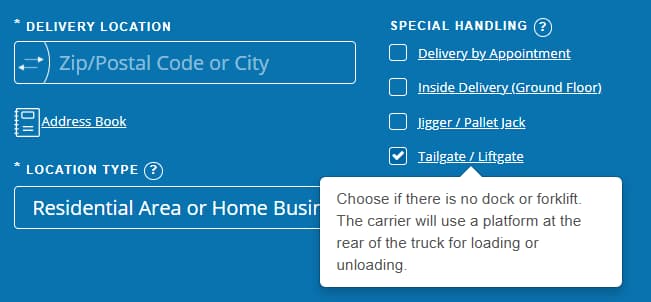
On Freightera, selecting liftgate up front in just a click means it is built into your all-inclusive quote. When your booking information is accurate, and a carrier tries to add an incorrect charge to your invoice, Freightera’s Rate Defense™ gives you a safety net by challenging misapplied accessorials on your behalf.
Liftgate/tailgate in freight shipping FAQ
Is a liftgate automatically included with my LTL shipment?
No. Liftgate is usually an optional, chargeable service. You have to select it when you get a quote or place a booking. If you are unsure about whether the location has the means to load/unload the shipment, it is safer to add a liftgate up front than to risk a missed attempt and extra charges.
How heavy can my pallet be for liftgate service?
As a practical rule of thumb, many liftgates handle about 1,300–1,500 lb per lift on a standard 48 × 48 pallet with an evenly distributed load. If your freight is close to this range, check the weight carefully and consider splitting heavy pallets into smaller ones.
What happens if I don’t book a liftgate but actually need one?
If the driver arrives and finds no way to safely load or unload, they will typically mark the shipment as undeliverable and return with proper equipment the next day. This often results in missed attempts and redelivery fees, and delays your shipment.
Ready to get your all-inclusive freight quote?
If you are not sure whether you need a liftgate at pickup, delivery, or both, you can flag that in your Freightera quote. Our team can help you match the right service level to your real on-site conditions so you avoid missed attempts, surprise accessorials, and unnecessary delays.