
Forklift Loading for Palletized Freight
A practical guide to forklifts in freight shipping
Forklifts are the workhorses of loading and unloading palletized freight. If you don’t have a truck-height dock, a forklift can often act as your “dock alternative.”
When a location has a forklift and someone trained to use it, loading and unloading usually go much faster and smoother than hand-unloading or relying on a liftgate for heavy pallets. But forklifts also have clear limits: overloading them, picking up pallets incorrectly, or working on uneven ground can put people, equipment, and freight at risk.
This guide explains what a forklift can realistically handle, when a forklift is not enough, and what to have in place before the truck arrives.
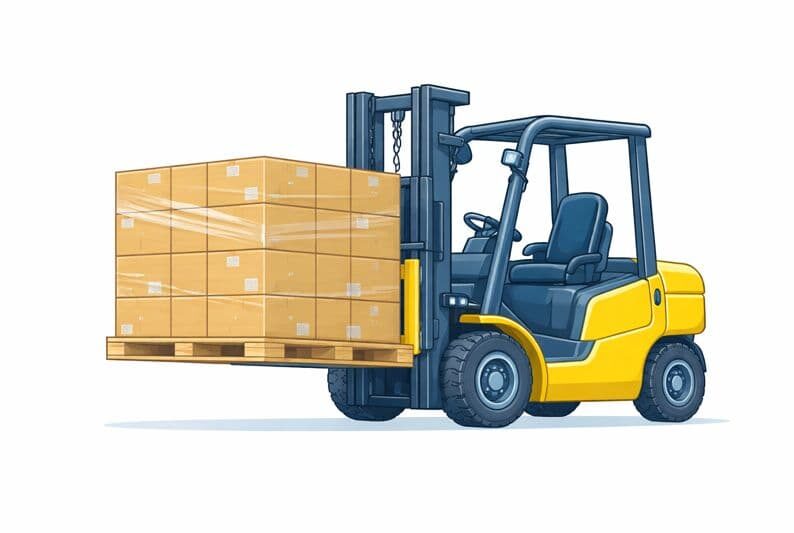
What a forklift does in freight loading
In the context of LTL and FTL shipping, a forklift primarily moves palletized or crated freight between the ground, your warehouse, and the trailer.
It helps you load and unload faster by handling one full pallet at a time, and it makes freight placement easier (for example, positioning heavier pallets over the axles or reorganizing your staging area before the truck departs).
Compared to a liftgate or hand unloading, forklifts are typically more efficient for multiple pallets or heavier loads, and more flexible because they can operate at a dock, at ground level, or with a ramp. The trade-off is that forklifts are more demanding when it comes to space: they need clear aisles, firm and relatively level ground, and enough room to approach, turn, and work safely without rushing or improvising.
If your location or consignee has a forklift and clear access for a trailer, it’s usually much better equipped to handle pallet freight than a site that relies only on manual lifting.
Forklift capacity 101: reading the data plate
Not all forklifts are the same.
- Every forklift has a capacity (data) plate that spells out what it can safely lift. It lists the forklift’s maximum rated capacity (for example, 3,000 lb, 5,000 lb, or 8,000 lb), the load center the rating is based on (commonly 24 inches), and any derated capacities that apply when the mast is raised to certain heights or when specific attachments are installed.
- It’s important to understand that a rating like “5,000 lb at a 24-inch load center” is not a universal guarantee in every real-world scenario. If your load is longer, taller, top-heavy, or shifted forward, the forklift’s effective capacity drops because the center of gravity moves away from the mast. Attachments like clamps, booms, or extended forks can reduce safe capacity as well, even when the forklift looks “big enough.”
- For freight shipping, the practical takeaway is simple: weigh your pallets accurately and compare that weight (plus how the load is built) to what your forklift can realistically handle. If you’re near the limit, keep the load tight to the mast, low to the ground, and move slowly and deliberately. And when you’re unsure, treat the capacity rating as a hard limit, not a suggestion.
- Typical warehouse forklifts handle around 3,000–5,000 lb per lift. Specialized equipment can go much higher, but if your freight is getting close to those numbers, double-check the plate and consider whether a different method (crane, heavy-duty lift, or truck-mounted equipment) is required.
When a forklift is not enough for loading/unloading
Even a strong forklift cannot solve every loading problem. A forklift may not be a suitable piece of equipment for loading/unloading when:
- The freight is too heavy: Your pallet weight exceeds the safe capacity of your forklift for that load size and height, and lifting it anyway risks tipping the forklift or dropping the load.
- There is not enough space: Tight alleys, steep slopes, gravel, or uneven surfaces make it unsafe to maneuver with a loaded forklift. Limited turning space increases the risk of hitting trailers, doors, or other equipment.
- The trailer can’t be safely boarded with a forklift: for example, it isn’t secured against movement, the dockboard/bridge plate isn’t strong enough or can’t be secured to prevent slipping, the trailer floor may not support the forklift and the load, or the entry-door clearance isn’t adequate (taking the loading platform height into account).
- The freight is extremely long or unbalanced: Long pipes, beams, or oddly shaped machinery can shift the center of gravity too far forward, even if the weight is within the stated capacity.
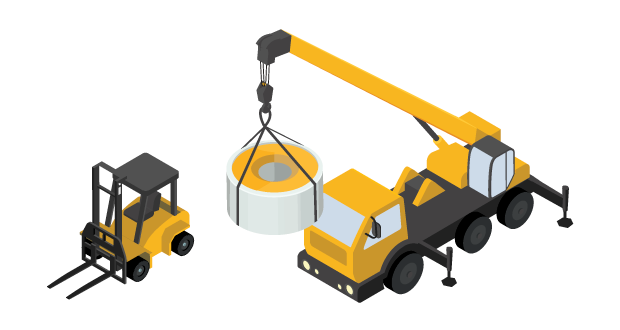
In these situations, you may need:
- A dock instead of ground-level loading.
- A portable loading ramp to create a safe angle and entry point.
- A crane or truck-mounted lift for extremely heavy or oversized pieces.
The goal is always the same: choose a method that keeps both people and freight safe.
When a forklift can act as your “dock alternative”
Many locations do not have a raised, truck-height dock, but they do have a place where a trailer can park, a forklift on site, and enough hard, level surface to work on safely. In these conditions, a forklift is a practical substitute for a dock.
In that setup, the location becomes effectively “dock-capable” for pallet freight because your team can approach the trailer from the rear or side, remove pallets directly from the trailer floor, and move them into the building or staging area without needing a liftgate.
This is why, during quoting, many shippers will mark the location as “business with loading equipment / dock” if a forklift is available and the trailer can be accessed safely – even if there is no raised platform.
For this to work safely and honestly, you still need a clear plan for where the trailer will park, enough room to approach straight-on without sharp angles or obstacles, and ground that is solid and relatively level (not deep gravel, mud, or a steep slope).
If any of those conditions are missing, it is usually better to book a different setup upfront, such as liftgate service (if the pieces are within liftgate limits), terminal pickup/drop-off (so the carrier handles loading at a proper dock), or specialized equipment like a crane, truck-mounted lift, or heavy-duty forklift for freight that cannot be handled safely with a standard forklift approach.
How to prepare for a forklift-based pickup or delivery
To keep things smooth when you are relying on a forklift, a little preparation goes a long way.
1) Confirm your forklift capacity and condition
- Make sure the forklift is operational, fueled/charged, and on-site before the pickup window. Inspect forks, tires, and mast for obvious issues before the truck arrives.
- Check the capacity/data plate and confirm it comfortably covers your heaviest pallet.
2) Stage freight where the forklift can easily reach it
- Keep pallets close to the loading area, but leave enough room to maneuver safely.
- Make sure pallets are wrapped, strapped, and stable before you move them.
- Avoid stacking pallets too high in staging if ceiling height or visibility is limited.
3) Plan the truck’s parking spot
- Decide in advance where the driver should park or back in.
- Make sure the path is clear of parked cars, bins, and loose pallets.
- If loading from ground level, choose a spot with the flattest, firmest surface available.
4) Coordinate people and timing
- Have a trained forklift operator available during the pickup/delivery window.
- Keep other staff clear of the immediate work area while the forklift is moving.
- Have your Bill of Lading (BOL) and paperwork ready so the driver is not waiting unnecessarily.
Forklifts in freight shipping FAQ
What size forklift do I need for LTL pallets?
For most standard palletized shipments, a 3,000–5,000 lb capacity forklift is sufficient, as long as your pallets are within that range and have standard dimensions. Heavier or oversized machinery, stone, or steel may require a higher-capacity unit.
What if my pallets are close to the forklift’s maximum capacity?
Treat the rated capacity as a firm limit. If your heaviest pallets are near that number, consider splitting the load into two lighter pallets, using a higher-capacity forklift for that shipment, or choosing a different loading method (for example, crane or truck-mounted equipment).
Is a forklift enough if I don’t have a dock?
Often yes, if you have safe, flat ground and enough room for the trailer and forklift to work. Many locations without docks load/unload from the ground using forklifts. If access is tight, uneven, or the freight is extremely heavy or oddly shaped, you may need a different solution.
How does forklift use affect my quote?
If a location has a forklift and can safely load/unload, you can usually book it as “business with a dock” rather than paying for a liftgate or special services. The key is that reality must match what you booked; if the driver arrives and you cannot load/unload as expected, you can be charged for a missed attempt and a reattempt.
Ready to ship your freight?
If you are not sure whether your forklift setup is sufficient for a particular shipment, our team can help you think it through before you book. Get an instant LTL quote on Freightera, book your shipment in minutes, make sure to note your loading/unloading setup, and we can help you match the right carrier and services to what you actually have on site.