
Hand Unloading Freight (“Handbombing”) in LTL Shipping
What hand unloading is in LTL shipping: limits, risks, and best practices
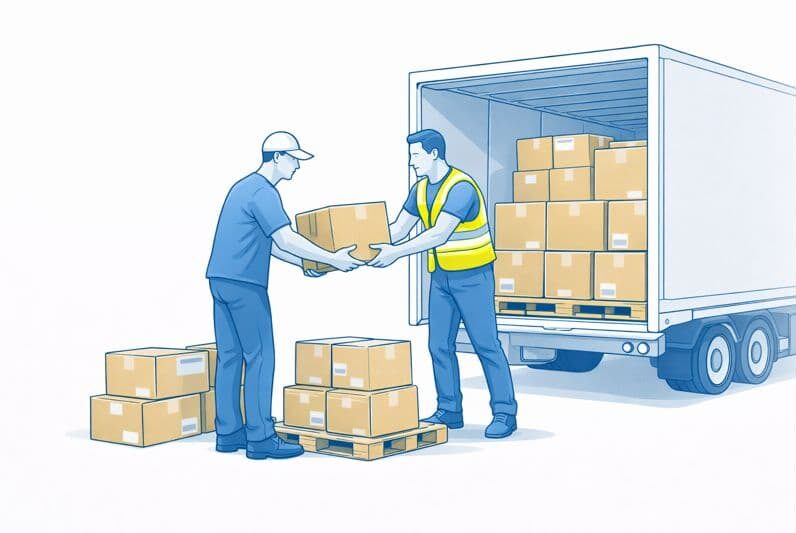
Hand unloading (often called “handbombing”) is exactly what it sounds like: moving freight off (or onto) the truck by hand, piece by piece, instead of using a dock, a forklift, a ramp, or a liftgate.
It can work well for light, manageable items when there’s no equipment on site. But it comes with safety rules, time limits, and carrier policies you need to respect. Handbombing the wrong load can cause injuries, delays, and extra fees.
This guide explains when hand unloading is acceptable, what carriers typically allow, how to do it safely, and when you should choose another method.
What hand unloading actually means
In freight shipping, “handbombing” usually means the shipment is unloaded as individual pieces, not as a palletized unit. The freight is not on a pallet or crate, or the pallet/crate is opened on the truck so boxes can be removed one by one. Most commonly, the driver will hand the individual packages to your staff, who will not be allowed onto the truck.
The on-site staff then carry the pieces by hand a short distance, as long as the pieces are light enough to lift and move safely.
A few important clarifications:
- Hand unloading does not mean the driver will break down and distribute a large shipment throughout your building, floor by floor, or room by room.
- It also does not replace proper packaging: if pieces are poorly packed, they are still more likely to be damaged during handling.
- And it does not remove the need for a safe unloading setup: you still need solid ground, a clear path, and a workspace that avoids tripping hazards or unsafe lifting.
When hand unloading makes sense for your freight shipment
Hand unloading is usually a good fit when the shipment is made up of small, manageable pieces (usually carton boxes), and the total shipment weight is relatively low, for example, a few hundred pounds spread across many light boxes.
It’s also a practical choice when there is no dock and no forklift, and a liftgate is unnecessary, unavailable, or not the best option, as long as you have enough people on site to unload within the carrier’s free time window.
This is often the simplest option for a small retailer receiving several light cartons of product, a workshop taking delivery of easy-to-carry parts, or residential and job site deliveries where the items are light and palletizing would be an overkill.
The moment pieces become heavy, bulky, high-value, or oddly shaped, hand unloading stops being “simple” and turns into a damage risk and safety issue fast. In such cases, it’s usually smarter to palletize, use a liftgate, or plan for other unloading equipment.
Hand unloading: the key limits, safety basics, timing, and when to choose another unloading method
If you’re planning to hand unload freight, it helps to treat it like a service with real limits, not a casual workaround. Carriers have piece-weight rules, drivers have safety restrictions, and most shipments come with a short free unloading window before extra charges can kick in.
The guidelines below will help you avoid surprises, unload safely, and know when it’s smarter to choose a dock, forklift, liftgate, or terminal instead.
Carrier limits when it comes to handbombing
- Hand unloading is typically allowed only for light, manageable pieces (often around 50 lb per item, sometimes less).
- Carriers usually include a short free unloading window in the base rate.
- If unloading takes longer than the free window, detention/waiting time charges may apply.
- Drivers are not always required or allowed to manually lift heavier items due to safety and liability.
If any piece feels too heavy, bulky, or oddly shaped for one person, plan for two-person lifts, dollies, carts, hand trucks, pallet jacks, or an entirely different unloading method.
When to choose another unloading method instead
You should choose another method or equipment if any of the following apply to your shipment:
- The pieces are very heavy, high-value, easy to drop, or hard to grip safely.
- You are moving a lot of freight (for example, anything approaching multiple pallets’ worth by hand).
- The unloading path is long, steep, cluttered, or there are unsafe site conditions (vehicle traffic, poor lighting, slick surfaces).
- You already know unloading will be slow, or the shipment will likely exceed the carrier’s free time window.
If timing is the problem, you can often solve it by:
- Reducing weight per piece (splitting heavy cartons into smaller ones).
- Choosing a liftgate instead of hand unloading (which is usually cheaper too).
- Using terminal drop-off/pickup and unloading on your schedule.
- Quoting driver assistance or inside delivery in advance (when available).
If you plan to hand unload your freight, check with your shipping provider or with Freightera before booking so the service and expectations are quoted correctly.
Hand unloading (handbombing) in freight shipping FAQ
Can I hand unload any shipment to save money on equipment?
Not safely. Hand unloading is best for light, manageable pieces. Heavy, bulky, or high-value freight should be on a pallet or in a crate and handled with proper equipment (dock, forklift, liftgate, ramp, or crane).
Will the driver help me hand unload?
Sometimes, but not always. Basic LTL service does not guarantee driver-assist. If you expect the driver to help break down pallets or carry pieces, you need to request driver-assist or inside delivery when you get your quote, not at the last minute.
How heavy is “too heavy” to handbomb?
There is no single number for every situation, but as a rough guide, anything approaching 50 lb per piece is already borderline for one person under ideal conditions. If in doubt, treat it as a two-person lift or use equipment instead.
Can I hand unload if my shipment arrives on pallets?
Yes. The driver can open the trailer, and you (and your team) can break down the pallet on the truck and carry pieces off one by one – if the carrier allows it and it is safe to do so. Keep in mind this may take longer and could lead to waiting time charges if it exceeds the free unloading time window.
Is hand unloading allowed at residential addresses?
Often yes, but it depends on the carrier, the size and weight of the pieces, and site safety. For many residential deliveries, a combination of liftgate plus hand unloading of smaller boxes is the most practical option.
Still not sure what’s right for your shipment?
If you are unsure whether hand unloading is acceptable for your shipment – or whether you should request liftgate, terminal pickup, or driver-assist instead – you can flag that when you request a Freightera quote. Our team can help you choose a method that keeps your freight and your people safe, and surprise fees to a minimum.