
Customs/Commercial Invoice for Cross-Border Freight Shipping
Learn what the customs/commercial invoice is, and how it’s used for shipping cross-border USA⇄Canada
A commercial invoice (sometimes called a customs invoice) is one of the most important documents for cross-border freight shipping. It tells customs agencies what the goods are, what they’re worth, where they were made, who’s buying and selling them, and how they’re packaged.
If the invoice is incomplete, inconsistent, or arrives too late, your shipment can be delayed at the border and you may see extra fees from carriers.
This guide is general information for importing and exporting freight between the USA and Canada. Customs requirements vary by commodity, value, and clearance method. Always confirm all the information with your customs broker before booking the freight shipment.
When you need a commercial/customs invoice
You’ll typically need a commercial invoice (or a Canada Customs Invoice, depending on the country and process) whenever freight crosses a border. Even when there’s no sale (samples, replacements, warranty goods, returns), customs still needs an invoice-style document that declares the goods and their value.
For import into Canada, CBSA accepts an invoice that meets their requirements. Practically, that can be either a commercial invoice or a Canada Customs Invoice (CCI). In some cases, shippers use both to ensure all required fields are included.
For import into the USA, CBP generally requires a commercial invoice.
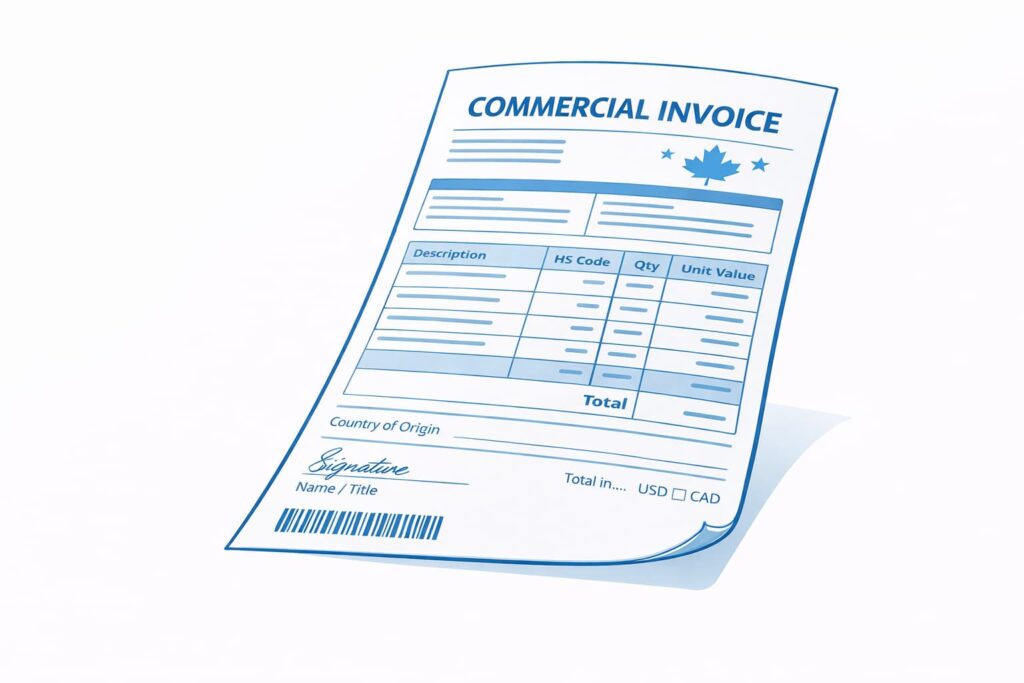
What must be on a customs/commercial invoice for customs clearance
Below is a helpful checklist of what you can expect to include on your customs/commercial invoice, but when in doubt, it’s best to follow your broker’s preferred format and data requirements.
- Seller/Shipper: legal business name and full address
- Buyer/Consignee: legal business name and full address
- Ship-to address
- Detailed description of each item: what it is, what it’s made of (when relevant), and how it’s known in trade
- Dimensions, weight and quantity (number of packages)
- Specified currency: whether the declared value is in CAD or USD
- Country of origin: where the goods were manufactured (not where they’re shipping from)
- Packaging / package markings: marks/numbers on packages, and what’s packed in each package
- HS / tariff code (if you have it): this speeds classification and reduces follow-up questions
- Incoterms (if you use them): they clarify who is responsible for what costs/risk
- PO number / reference numbers: these help match documents to the shipment and broker file
- Name of a person at the exporter/seller who will be available to answer questions, if needed
- Conditions of sale and terms of payment: commonly required for shipments entering Canada
Be accurate and specific
Ambiguous descriptions are one of the fastest ways to trigger customs requests, inspections, and delays. Make sure that the item descriptions on the customs invoice are specific enough to classify the goods correctly. For example, instead of “Parts,” “Hardware,” and “Accessories,” you should write “Steel mounting brackets for shelving, zinc-coated, for retail fixtures” and “Plastic cosmetic pump tops, PP plastic, for 250 ml bottles.”
Additionally, the data on your commercial invoice, BOL, and labels should match when it comes to the identifiers customs, brokers, and terminals use to match the freight to the right shipment file:
- Buyer/Consignee name and address should match across documents
- Ship-to destination (city/state/province + postal/ZIP) should match across documents
- Package/handling unit counts should match (pallets/crates/cartons)
- Reference numbers should match (BOL/PO/order/shipment reference)
- Weight and dimensions should be consistent across the booking details, BOL, and invoice
Packing list
A separate packing list is very important when customs wants to inspect specific packages and your freight is mixed (multiple SKUs / multiple carton types).
Use a packing list when shipping multi-item shipments, and make sure the packing list aligns with the invoice line items and package counts.
Certificate of Origin
A Certificate of Origin (CoO) can be requested depending on the commodity, the importing country’s rules, preferential duty treatment claims, and broker/customs requests based on how the goods are declared.
Commercial/customs invoice in freight shipping FAQ
Can I use a receipt instead of a commercial invoice?
Sometimes a receipt can work if it contains the required fields that customs needs, but the safest approach is a proper commercial invoice format with clear line items and declared values. Always check with your customs broker.
What’s the difference between a pro forma invoice and a commercial invoice?
A pro forma invoice is often used for quotes or internal/pre-sale purposes, and it typically doesn’t replace a commercial invoice for border clearance.
What does “country of origin” mean on the invoice?
This is the place where the goods were manufactured/produced, not the pickup location or where the seller is located.
Ready to ship freight cross-border (USA⇄Canada)?
Use Freightera’s online platform to compare cross-border rates from 100s of carriers, book 24/7, and get automated shipment updates. Our 5-star Client Care team is there to help you every step of the way.