
Limited Access Locations in Freight Shipping
How carriers define “limited access” locations, why they cost more, and how to avoid surprise fees
In freight shipping, not every non-residential address is considered a “regular” business location.
Some places are harder for trucks to reach, slower to get in and out of, or require extra steps like security checks or appointments. Carriers call these limited access locations.
If you do not mark a limited access location when you quote, you can end up with:
- Missed pickups or deliveries (if the driver is turned away, or unable to get in);
- Redelivery and extra handling fees added to your invoice.
This guide explains what “limited access” means in practice and how to correctly quote for limited access locations.
What do freight carriers mean by ”limited access locations?”
A location is usually treated as limited access if one or more of these are true:
- It is not open to the general public during regular business hours;
- Appointments are required for pickup or delivery;
- There are gates, guard shacks, or security checks;
- The site cannot easily handle a 53 ft. trailer (because of tight access, special routing, or simply because the location is very remote).
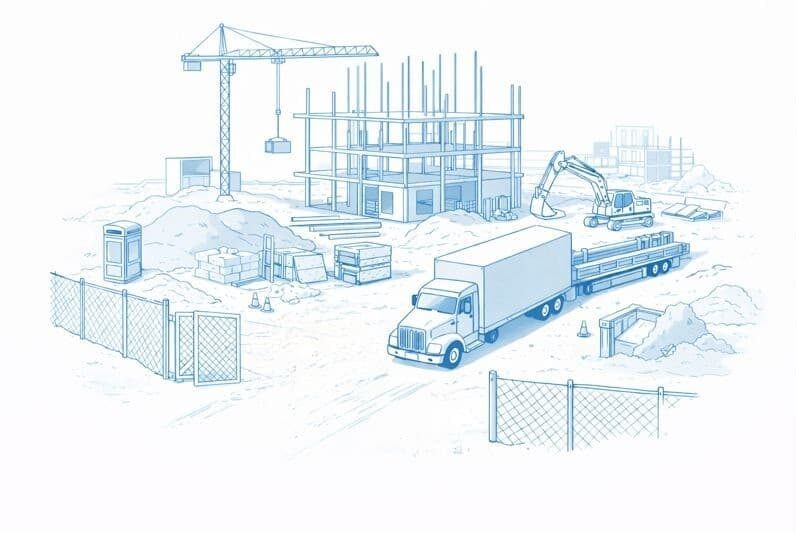
Common examples of limited access locations:
- Airports, seaports/ports, rail yards, marinas, and piers/wharfs;
- Hospitals, clinics, nursing homes/assisted living facilities, animal hospitals, and other medical sites;
- Schools, universities, daycares, preschool facilities, and public libraries;
- Churches, temples, cemeteries, and funeral homes;
- Military bases/installations, prisons, police and fire stations, and other sites with extensive security processes;
- Construction sites, mines, quarries, and other job sites (including locations that require non-standard equipment);
- Utility and critical infrastructure sites, including power plants, nuclear facilities, and water treatment plants;
- Farms, ranches, and other remote rural facilities;
- Parks (including state/national parks), fairgrounds, convention and expo centers, amusement parks, golf courses, country clubs, and resorts (including ski resorts);
- Storage units/mini storage facilities, shopping malls, casinos, and other commercial establishments not open to the general public during normal business hours (including some warehouses/distribution centers such as Amazon locations), plus banks and post offices/USPS processing centers;
- Lodging facilities, restaurants, gas stations, car washes, and car dealerships.
This list is not complete. Carriers can treat other “non-standard” locations as limited access too.
Why does shipping to or from limited access locations cost more?
Limited access usually means extra work and time for the carrier:
- Extra time for security checks, check-in procedures, and getting directions on site;
- Appointments that restrict when the driver can arrive;
- Detours or remote roads to reach the location;
- Slower movement because of pedestrians, tight turns, or restricted areas;
- Sometimes, the need for a smaller straight truck instead of a 53 ft. trailer.
All of that adds up to more time and a higher cost per stop, which is why carriers charge a limited access fee when it applies.
If your locations are limited access, and you do not declare it up front, the carrier will usually charge you a limited access fee afterwards, and possibly add missed pickup/delivery fees if they have to dispatch the truck again.
High security sites, Amazon FBA, and big distribution centres
Some locations are technically “businesses,” but carriers still treat them as limited access because of strict rules and long wait times.
Common examples:
- Amazon FBA and other large fulfillment centers
- Big distribution centers (DCs)
- Ports, airports, and rail terminals
- Other high-security facilities (such as military and government sites)
What these limited access business locations usually have in common:
- Mandatory appointments booked through a portal or scheduling system
- Required reference numbers or IDs
- Security check-in with guards, badges, or special instructions
- A higher risk of long wait times and detention if the schedule slips
For Amazon FBA specifically:
- Delivery appointments are set directly in Amazon’s portal (note that neither Freightera nor the carrier have any control over the date or time of the assigned appointment; the appointment time and date depend entirely on Amazon);
- Your shipment usually needs all required Amazon reference numbers on the BOL and labels;
- Only certain carriers deliver to specific Amazon sites. On Freightera, when you select a special delivery to an Amazon warehouse, our system filters for carriers that accept Amazon freight on those lanes.
Treating Amazon, big DCs, and other secure facilities as limited access with extra rules keeps your quote realistic and helps you avoid missed attempts and surprise charges later.
Freightera can help you find vetted carriers that deliver to Amazon and other high-security sites with proper scheduling and documentation.
How to tell if your location is a limited access location:
If you are not sure, ask yourself a few simple questions:
- Can any truck drive in during normal business hours without an appointment?
- Can the driver just show up, check in, and back into a dock (like at a regular warehouse)?
- Is the site easy to find and open to the public during regular business hours?
If the answer is no to one or more of these, your site is probably a limited access location.
How to quote and book correctly if your location is ‘limited access’:
When you get a freight quote, you should:
- Select “limited access” for pickup and/or delivery;
- Indicate whether the location can handle a 53 ft. trailer or needs a straight truck;
- Indicate whether a delivery by appointment is required.
Then, while booking, provide:
- Full address and business/site name;
- Hours of operation and any closure times;
- Any gate or special security instructions (IDs, gate codes, etc.);
- A reliable on-site contact name and phone number.
For special locations (like Amazon FBA or certain DCs):
- Use the dedicated options on the quoting page (for example “Amazon”) when available;
- Make sure all required reference numbers or IDs are shown on the BOL and labels.
The closer your quote matches reality, the lower the chance of the truck being turned away, of missed pickup or delivery attempts, and of unexpected limited access or redelivery charges added later.
Freightera helps prevent these issues by guiding you during quoting, and flagging possible limited access locations.
Limited access locations in freight shipping FAQ
We have a dock and a forklift. Why are we still considered limited access?
Limited access is about how the truck reaches you, not just your loading/unloading equipment. If your site has security, gated entry, appointment-only access, or heavy pedestrian traffic (like a hospital, church, or campus), carriers will still treat it as limited access.
Our farm can easily take a 53 ft. truck. Is it still limited access?
It depends. Farms are frequently considered limited access because they are remote and take extra time to reach, even if maneuvering is easy once the truck arrives.
The carrier said my location was limited access after the delivery, and I got a limited access fee. Can this fee be removed?
Sometimes, but not always. If the location really fits the carrier’s limited access rules, the charge is usually valid. Declaring that your location is limited access during quoting is the best way to avoid surprises.
Note: Freightera’s Rate Defense™ protects you from unfair extra charges. All additional services need to be selected during quoting. If a carrier performs a service not checked off, it’s fair for them to charge for it, but we do protect you from any unfair or invalid carrier fees.
What if I am not sure whether my location is limited access?
If you are unsure, it is safer to ask for help before booking. You can describe your site (photos, map view, notes about gates and access), and our team can help you choose the right option. Contact us at [email protected].