
When a 53’ Truck Can’t Reach the Location
What happens when a full-size trailer can’t access your location, and how to plan around it
Most LTL and FTL shipments involve a full-size highway truck with a 48-53′ trailer.
If that truck cannot safely reach your pickup or delivery point, you are likely to get missed attempts, redelivery fees, and delays.
The good news is that if you know this in advance, you can request a straight truck, and your shipment can still move smoothly.
Alternatively, you could schedule a terminal pickup or delivery and have the freight picked up or delivered from or to a carrier terminal.
Common reasons a 53′ truck cannot get in
A standard 53′ truck needs:
- Streets and corners wide enough to turn;
- Overhead clearance for bridges, wires, trees, and signs;
- Enough room to back up to a dock or driveway;
- No weight or length restrictions that block heavy vehicles on the roads.
If any of these are a problem, a standard 53′ trailer may not work for your site, even if the address is technically “business” or “commercial.”
Here’s what to watch for at your pick up/delivery location:
- Tight residential or downtown streets: narrow lanes, cars parked on both sides, traffic-calming features, or cul-de-sacs can make turning or backing unsafe.
- Very sharp turns or small yards: the tractor and trailer need room to swing. If the yard or driveway is short or angled, the truck may not be able to line up with your dock or door.
- Low clearances: bridges, power lines, tree branches, balconies, or awnings that hang low can block or damage a full-size trailer.
- Weight or truck restrictions: signs like “no trucks,” low bridge weight limits, or time-of-day bans for heavy vehicles can prevent legal access.
- Steep roads and rough surfaces: steep hills, or rough surfaces (unpaved gravel, or dirt roads that can get muddy after rain) can be difficult or unsafe for a loaded truck.
If any of this sounds like your location, assume a 53′ truck might not be able to reach it, and plan accordingly.
How to check truck access before you book
If you are not familiar with the location, a quick check can help. Below are a few tips on how to do this before you request a quote:
- Ask someone on site: call the location and ask whether the location is accessible by a 53’ truck.
- Look it up on a map: use satellite and street view to see road width, corners, and where a truck could park, turn, or back in. Check whether there is a dock, or only a driveway, and see if there’s enough room for the truck to access and turn around.
If you see any red flags, you should plan to use smaller equipment or a different delivery option.
What to do when a 53′ truck cannot reach your location
You still have choices if a full-size trailer will not work at your address.
1) Request a straight truck or a smaller truck
A straight truck (often 24-28′) can go places a 53′ truck can’t. It’s better for tight residential or downtown streets, and easier to maneuver into short or angled driveways.
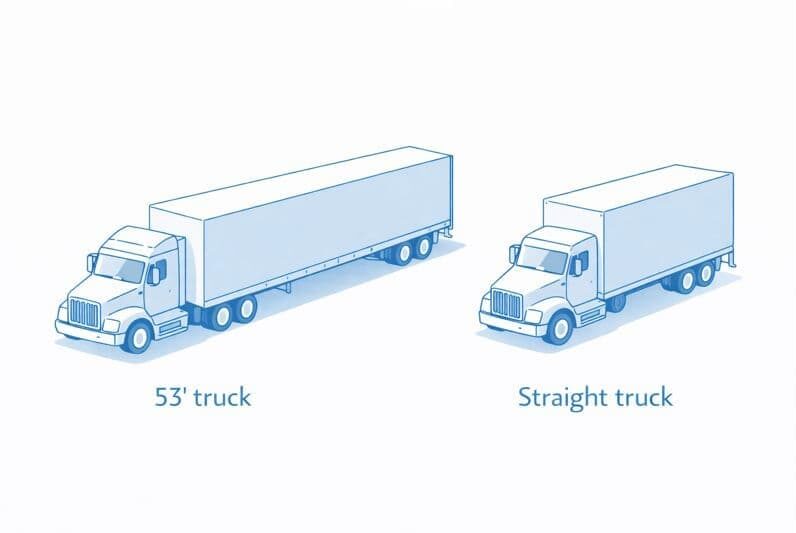
Keep in mind: smaller trucks have lower weight and space limits. Very heavy or high-cube loads may still need a full-size trailer and an alternate plan, such as terminal pickup.
2) Use carrier terminal pickup or drop-off
For tricky addresses, you can deliver to the carrier’s terminal, or have the carrier deliver to their own terminal and pick up from there yourself.
You then handle the short local portion of the shipment with your own vehicle or a smaller truck.
This can be cheaper and simpler than repeated failed attempts at a hard-to-access location.
3) Arrange a nearby handoff
Some shippers choose to meet the truck in a nearby parking lot or industrial area, and load or unload there with their own forklift or crew.
This requires coordination and your own equipment, but it avoids forcing a 53′ truck into a tight or restricted street.
How location access affects price and timing
Planning for access up front usually saves money overall.
You might pay a bit more for:
- A smaller truck or straight truck
- Limited access or residential service
- Terminal handling if you pick up or drop off there
But you avoid common extra charges such as:
- Missed pickup or delivery fees
- Redelivery attempts
- Detention for time spent turning around or looking for access
- Schedule slip when the carrier has to rebook the load
A realistic plan is almost always cheaper and less stressful than sending a big truck and hoping the location can accommodate it.
53′ truck access in freight shipping FAQ
How do I know if a 53′ truck can come to my address?
Check the street view on Google Maps, and call the site to ask if 53′ trailers can access the location. If nobody is sure, it is safer to assume you need a smaller truck or terminal pickup. If a location has a loading dock, it’s generally safe to assume it can accommodate a 53’ truck.
What happens if a 53′ truck shows up and can’t get in?
The driver will usually have to leave and report a missed attempt. That can mean redelivery fees, delays, and sometimes detention if they spent time trying to access the site or turning around.
Can the carrier just switch to a smaller truck automatically?
Usually not. Smaller trucks and drivers have to be scheduled and may not be available the same day. If the carrier has to re-dispatch with different equipment, it is treated as a new attempt and often comes with extra charges.
Is picking up at the terminal cheaper?
Often yes, especially if your site is very tight or far off main roads. You avoid residential or limited access surcharges and reattempt fees and only pay for the main linehaul plus any terminal handling. You will need to arrange the short local move to or from the terminal.
Still not sure if a 53′ can reach your pickup or delivery?
Share the address and a quick description of the site with the Freightera team at [email protected]. We can help you choose between a straight truck, terminal pickup/delivery, or a standard trailer so your driver can get in, out, and on the road without surprises.