
How LTL Freight Shipping Works, and When to Use It
Learn what LTL freight shipping is, how it works in practice, and when to use it for your business
Less-than-truckload (LTL) shipping moves palletized or crated freight that doesn’t fill a whole trailer. Multiple shippers share space and cost, and the freight typically flows through a terminal network where pallets/crates are consolidated and transferred en route.
Typical LTL loads are about 1-10 pallets and often fall in the ~150-15,000 lb range, which is why pallet shipping is the norm for most businesses.

When to use LTL freight shipping
LTL shipping might be the right choice for your business if any of the following are true:
- Your freight is over the parcel limits. If a single piece is over the common parcel thresholds (about 150 lb or 165 in. length-plus-girth), LTL is the next step up.
- You want safer, simpler handling of freight. Putting several boxes on one pallet reduces touches and misroutes (compared to shipping many oversize parcels).
- You don’t need a whole trailer. If your freight routinely fills most of a trailer, full-truckload (FTL) may be more cost-effective. If you’re shipping less than half a truckload, LTL is your best choice.
How LTL shipping works in practice
LTL shipping follows a predictable process. The steps below will walk you through what that looks like end-to-end, so you know what to expect and what steps to take:
- Package your shipment: palletize or crate the freight so it moves as a stable handling unit, wrap or strap it securely so nothing shifts or comes loose in transit, and apply clear labels on each handling unit so terminals and drivers can identify and route it correctly.
- Measure and weigh the freight accurately (after packaging).
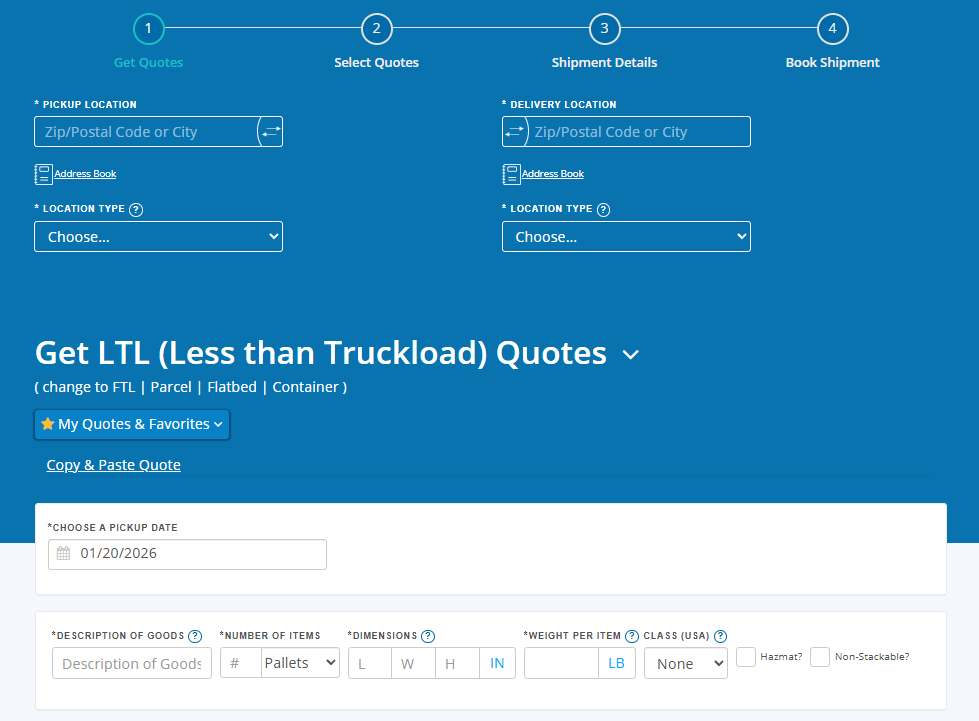
- Get freight quotes by entering shipment details (origin/destination, pickup date, pallet count, dimensions, weight, and special services).
- You’ll see a selection of available trucks and freight rates.
- Compare real-time quotes, choose the deal you want, and book your shipment online.
- On the pickup date, a local driver collects your pallets and returns to the origin terminal. After this point, your shipment is assigned a tracking number, so you’re able to track your shipment online.
- Freight bound for the same regions is loaded on a linehaul to a local terminal.
- At the hub/terminal, pallets are cross-docked and sent to the next hub/destination terminal.
- The destination terminal loads for local delivery and schedules appointments if needed.
- The truck is sent out for the final-mile delivery.
The key decisions in LTL shipping that impact cost and transit time
Here are some key choices that help you match LTL shipping to your needs, so you can choose the right approach, set the right expectations, and keep your operations running smoothly.
Parcel vs. pallet (LTL): when to switch
Parcel is ideal for smaller, lightweight boxes. Once you’re close to parcel limits or sending multiple boxes to the same receiver, consolidating onto a pallet and shipping LTL is usually the safer and more cost-effective move.
See Parcel vs. Pallet (LTL) Shipping for a detailed breakdown of the practical differences between parcel and pallet shipping so you can choose the right option for each shipment.
LTL vs. FTL: when a dedicated truck makes sense
LTL is built for smaller freight that doesn’t need a full trailer. But if the shipment is time-sensitive, high-value, fragile, or getting close to half a truck, it’s often worth getting an FTL quote too.
In this article, LTL vs. FTL: How to Choose the Right Freight Option, we explain how to decide between shared space (LTL) and a dedicated trailer (FTL) based on the shipment size, timing, and handling needs.
How LTL pricing works (and why quotes change)
LTL rates are shaped by your shipment details (dimensions, weight, space used), the lane, fuel, and any accessorials you need at pickup or delivery. Most “surprise charges” come from mismatched shipment info, missing services, or packaging realities that don’t match what was booked.
In the article How LTL Freight Rates Are Calculated, we walk you through the main pricing factors behind LTL quotes so you know what affects your rate.
Freight class (NMFC): when it applies and how to avoid reclassification
Within the USA or cross-border USA⇄Canada, many LTL carriers use NMFC freight class. Getting class or commodity details wrong can trigger reclassification and invoice adjustments, so it’s worth confirming before pickup.
Read NMFC Freight Class Explained for LTL Shipping to learn what freight class is, when it applies, and how to confirm the correct NMFC item for your shipment.
LTL freight shipping FAQ
Is LTL cheaper than parcel for ~200 lb?
Often yes, because 200 lb exceeds typical parcel limits; palletizing into LTL can reduce cost and damage risk versus multiple oversize parcels.
How are LTL quotes calculated?
Lane (origin/destination), fuel prices, and the space your shipment takes in the truck (linear feet) affect the freight rates. In the USA, many carriers price with NMFC freight classes (50–500) based on density, handling, stowability, and liability. For a detailed explanation on how freight rates are determined, see How LTL Pricing Works.
Why is most LTL freight palletized?
Most LTL freight goes on pallets because it makes handling safer and faster: forklifts can pick up a single, sturdy unit, terminals touch it fewer times, and trailers can be packed more neatly. Wrapping/strapping the load to the pallet and putting clear labels on the sides helps it survive the journey through the terminals, and keeps scans readable.
Do my pallets have to be stackable?
Not required, but stackable loads use space more efficiently; some carriers apply surcharges to non-stackable freight. Packaging your freight safely is important, so make sure the pallets you mark as ‘stackable’ can actually be stacked safely.
Why do ETAs change in LTL?
LTL freight makes several stops: it’s picked up locally, sorted at a hub/terminal, moved on a linehaul, then handled again at the destination terminal before final delivery. With multiple handoffs, things like weather, terminal backlogs, or traffic can affect timing, and this is why carriers list ETAs as estimates.
Ready to ship LTL?
If you’re ready to ship, go to Freightera and get instant LTL quotes in seconds from hundreds of vetted carriers, compare options side by side (including lower-emission choices when available), and book online 24/7.