
LTL vs. FTL: How to Choose the Right Freight Shipping Option
With these practical examples, you’ll know when to choose LTL shipping vs. FTL shipping
If you’re moving just a handful of pallets on a flexible timeline, LTL (less-than-truckload) keeps costs down by sharing trailer space with other shippers.
When you’re shipping more than a half-trailer’s worth, have tight delivery windows, or the freight is fragile/high-value, FTL (full truckload) gives you a dedicated trailer, fewer touches, and tighter schedule control.
LTL vs. FTL: Cost, transit, and risk at a glance
Here’s what to take into account when deciding on whether to ship LTL vs. FTL.
For small loads, LTL typically wins on price.
As the pallet count or cubic volume grows, or if the lane is long, FTL becomes more economical.
Transit is generally faster with FTL because there are no intermediate transfers.
On damage risk, FTL has the advantage (load once, unload once – you avoid multiple terminal touches), while LTL, despite being reliable, faces multiple touches and redistribution at terminals.
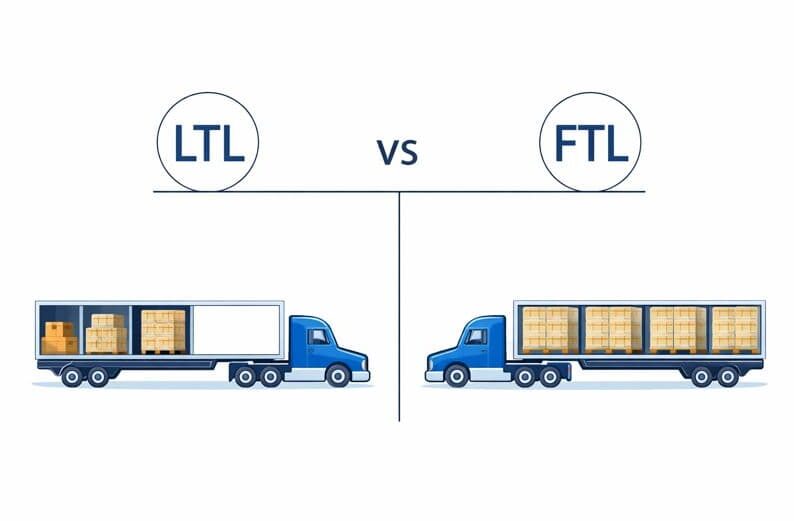
LTL vs. FTL: truck types
Most LTL shipments are moved in a dry van (enclosed 48–53 ft trailers).
On some lanes, you’ll also find LTL reefer service for freight that must stay within a set temperature.
With FTL, you choose the trailer type (flatbed, dry van, dropdeck, etc.) to match your freight and how it must be handled:
- Dry Van (standard enclosed): Best for palletized, boxed, or crated goods that don’t need temperature control. Loads via dock or forklift.
- Reefer (refrigerated/heated): For perishables or anything with a strict temperature range end-to-end.
- Flatbed: Open deck for freight that’s too wide/tall for a van or must be loaded by crane from the side/top. You can add tarps and tie-downs as needed.
- Step-Deck (drop-deck): Like a flatbed but lower in the rear to fit taller pieces without permits. Good for machinery and crated equipment.
- RGN (Removable Gooseneck): Very low deck that can “drive on/drive off” for extremely heavy or tall equipment. Used for the biggest, heaviest shipments.
When to Book LTL (Less Than Truckload)
Best for: 1-8 pallets, flexible delivery dates, standard dock-to-dock freight.
How it works: Your pallets share a trailer with other customers’ freight. After pickup, the driver brings them to a local terminal, where they’re grouped with other loads going the same direction, moved to the next terminal, and then sent out for delivery.
Because you’re sharing space (and cost) with other shippers, LTL covers a lot of lanes across the USA and Canada – great for regular restocks and smaller shipments.
Why shippers choose it: You pay only for your space and weight. It’s easy to add services like liftgate, residential delivery, or inside delivery at checkout.
Trade-offs: More handling at terminals; ETAs are estimated, not guaranteed. Since LTL pricing considers density, and class (in the USA, and USA⇄Canada cross border shipping), accurate dimensions, weight, and packaging help you avoid reweigh/reclassification fees.
When to Book FTL (Full Truckload)
Best for: Shipments that take up more than half a truck, tight schedules, high-value/fragile freight, or odd sizes.
How it works: The entire trailer is yours. The driver loads at the origin and runs straight to the destination with minimal or no stops. That direct path cuts handling to two touches (loading and unloading), which lowers damage risk and ensures your freight arrives on time for precise appointments.
Pricing: A simple function of the lane and equipment – there’s no NMFC classing to worry about.
Why shippers choose it: Volume requires it, or for faster door-to-door transit and more predictable scheduling.
Trade-off: You pay for the whole trailer (even if you don’t fill it), so it can cost more for small shipments.
LTL vs. FTL: Packaging & loading tips
For LTL (sharing the trailer):
- Build a tight pallet: keep everything inside the pallet edges (no overhang) and stack so the center of gravity stays low.
- Add protection: use edge protectors/corner boards, then strap and stretch-wrap starting around the pallet base and working up.
- Label clearly: put labels on at least two sides of the pallet and the top so terminals can scan them easily.
- Only mark “non-stackable” if stacking is truly unsafe – “non-stackable” can reduce available truck space and increase your price.
For FTL (your shipment takes the full trailer):
- Plan the load to ensure safe, stable stacking: focus on how pallets are stacked and arranged inside the trailer.
- Flatbeds/step-decks/RGNs: specify required additional equipment like tie-downs and tarps, and make sure pickup/delivery sites are ready for crane/forklift loading.
See this guide for best practices in packaging your freight shipment.
A practical decision guide on which option to choose for shipping: LTL or FTL?
1) How big is your shipment?
→ fewer than 6–8 pallets or fewer than ~10–12 linear ft: choose LTL
→ very tall/long pieces (or pieces with odd shapes): choose FTL
⇒ Practical scenario: 7 standard pallets (48’’ x 48’’ x 48’’), 8,500 lb total, no special needs: choose LTL.
2) How urgent is delivery?
→ Flexible ETA (you get a delivery arrival window, not a strict appointment): LTL can save money
→ Must-arrive date/window, just-in-time, or tight dock appointment: FTL (or Guaranteed LTL if available)
⇒ Practical scenario: 9 pallets must make a Thursday 10-12 a.m. dock appointment: choose FTL (dedicated truck for timing control).
3) How sensitive is the freight?
→ Crated/well-palletized and durable: LTL is fine
→ Fragile, high-value: FTL (minimal touches)
⇒ Practical scenario: 5 pallets of glass displays, professionally crated, moderate value: LTL works (if you package well).
4) What’s your budget compared to your risk tolerance?
→ Lowest cost for small, non-fragile loads: LTL
→ Lower damage risk + schedule control for time-sensitive loads: FTL
⇒ Practical scenario: 2 pallets of custom glass chandeliers (~$75k total) headed to a hotel with a tight delivery deadline: Book an FTL dry van with blanket-wrap and straps, seal the trailer, and send it direct (no terminal handoffs).
Use LTL when your freight is lower-value, and you’re comfortable with multiple terminal handoffs, shared trailer space, and longer transit windows. LTL keeps costs low, but comes with higher handling exposure and less schedule control.
Use FTL (a dedicated truck) when the shipment is high-value, fragile, time-sensitive, or has a strict delivery deadline. Even if you’re shipping several pallets (less than half a truck), FTL could sometimes be a better option if the cost of damage or delay is higher than the added cost of the truck. FTL eliminates terminal transfers and gives you better control over pickup and delivery timing.
If you’re unsure whether to get an LTL quote or an FTL quote, get both and compare!
LTL vs. FTL: FAQ
Can I get guaranteed delivery with LTL?
On many lanes, yes (for a fee). If you absolutely must hit a narrow window, FTL is still the safer option. LTL guaranteed services often cost significantly more, despite still not guaranteeing your freight will arrive on time. Congestion, weather, or truck breakdowns can impact the carrier’s transit time.
Do I need a freight class if I book FTL?
No. FTL pricing is based on lane and equipment. LTL uses additional factors for pricing, such as freight class in the USA (or cross border USA⇄Canada), or density, so accurate dimensions and weight matter while quoting.
Why are LTL reefers hard to find?
Because combining many small, temperature-sensitive shipments on one refrigerated trailer is tough to plan, risky to execute, and tightly regulated. “Reefer” doesn’t always mean cold – some shipments need heat, others freeze, each with its own airflow/handling rules and sanitation requirements (especially for food/pharma). This makes “sharing space” (the core of LTL) much more complicated than with dry freight. For the aforementioned reasons, Freightera does not offer reefer services at the moment.
Do I ship FTL or LTL if the shipment is small but very high-value?
Consider FTL to keep a seal intact and minimize handling, even if the trailer isn’t full.
Still not sure whether to ship LTL or FTL?
Just tell us your lane, pieces, dimensions, weight, and any special needs, and our team will recommend the correct service type (LTL vs. FTL) and the right equipment and accessorials.
On Freightera, you can quote for both options (LTL and FTL). Our Rate Defense™ protects you from unfair additional charges from freight carriers. Reach us at (800) 886-4870 Ext. 1 or [email protected].